

When Should You Consider a Neuropsychological Evaluation for Your Child?
When a child is struggling at school, at home, or in social situations, it is not always clear what is causing the difficulty. Parents may notice problems with attention, learning, memory, behavior, anxiety, emotional regulation, or completing everyday tasks, but these concerns can overlap.
A comprehensive child neuropsychological evaluation can help families understand the full picture.
At Neurobloom Psychological Clinic in Novi, Michigan, doctoral-level clinicians provide individualized neuropsychological testing for children and adolescents. Evaluations are designed to identify a child’s strengths, uncover areas of difficulty, and provide practical recommendations for school, home, and treatment planning.
What Is a Neuropsychological Evaluation?
A neuropsychological evaluation is an in-depth assessment of how a child thinks, learns, processes information, and manages emotions and behavior.
Depending on the child’s needs, testing may evaluate:
- Attention and concentration
- Memory and learning
- Language and communication
- Problem-solving and reasoning
- Academic skills
- Processing speed
- Executive functioning
- Emotional and behavioral functioning
- Social development
- Visual and motor skills
Unlike a brief screening or single test, a comprehensive evaluation considers multiple areas of functioning. This can help determine whether a child’s challenges may be related to ADHD, a learning disability, anxiety, autism spectrum concerns, developmental differences, or another condition.
Learn more about Neuropsychological Testing for Children and Adults
Signs Your Child May Benefit From Neuropsychological Testing
Every child experiences occasional frustration, distraction, or academic difficulty. An evaluation may be helpful when concerns are persistent, affect several areas of life, or do not improve with routine support.
Parents may consider a child neuropsychological evaluation when they notice:
- Difficulty paying attention or following directions
- Frequent forgetfulness or losing important items
- Trouble completing schoolwork or homework
- Reading, writing, or math skills below expectations
- Strong abilities in some subjects but significant difficulty in others
- Problems organizing assignments, materials, or daily routines
- Emotional outbursts, anxiety, or difficulty managing frustration
- Trouble making or maintaining friendships
- Slower processing or difficulty responding under pressure
- A noticeable change following an illness, injury, or medical condition
- School interventions that have not fully addressed the concern
- Uncertainty about an existing diagnosis
Testing can also be valuable when parents, teachers, and healthcare providers see different behaviors in different environments.

What Can a Neuropsychological Evaluation Help Identify?
A comprehensive evaluation does not begin with the assumption that a child has a specific diagnosis. Instead, it examines patterns across several areas to better understand what may be contributing to the child’s difficulties.
Neuropsychological testing may help evaluate concerns involving:
ADHD and Executive Functioning
Children with ADHD may struggle with attention, impulse control, organization, working memory, time management, and task completion. However, anxiety, learning difficulties, sleep concerns, and other conditions can sometimes look similar.
A full evaluation can help determine whether ADHD is present and whether other factors may also be affecting the child.
Learn more about ADHD and ADD Testing
Learning Disabilities
A child may work hard but continue to struggle with reading, writing, spelling, math, or understanding instructions. Psychological testing for children can help identify specific learning disorders and clarify the types of educational support that may be beneficial.
Anxiety and Emotional Concerns
Anxiety can affect concentration, memory, confidence, sleep, school attendance, and academic performance. Testing can help determine whether emotional concerns are contributing to a child’s difficulties or occurring alongside another condition.
Learn more about Counseling for Anxiety and Stress
Autism Spectrum and Social Development Concerns
Parents may seek an evaluation when a child has difficulty with communication, social interaction, flexibility, sensory experiences, or adjusting to changes in routine. A comprehensive assessment can examine these concerns within the broader context of the child’s development.
Memory, Processing, or Developmental Concerns
Some children experience difficulty remembering information, processing instructions quickly, solving problems, or developing skills at the expected pace. Neuropsychological testing can identify specific patterns and provide recommendations tailored to the child’s needs.

Why Comprehensive Testing Matters
Children’s symptoms do not always fit neatly into one category.
For example, a child who appears inattentive may be experiencing ADHD, anxiety, a learning disability, slow processing speed, poor sleep, or a combination of factors. Treating only the most visible symptom can leave important needs unaddressed.
A comprehensive evaluation considers the child as a whole. It can help answer questions such as:
- Why is my child struggling despite working hard?
- Is this ADHD, anxiety, a learning disability, or something else?
- What type of school support may help?
- Does my child qualify for accommodations?
- What are my child’s strongest abilities?
- Which strategies are most likely to be effective?
The goal is not simply to assign a diagnosis. The goal is to provide clarity and a practical path forward.
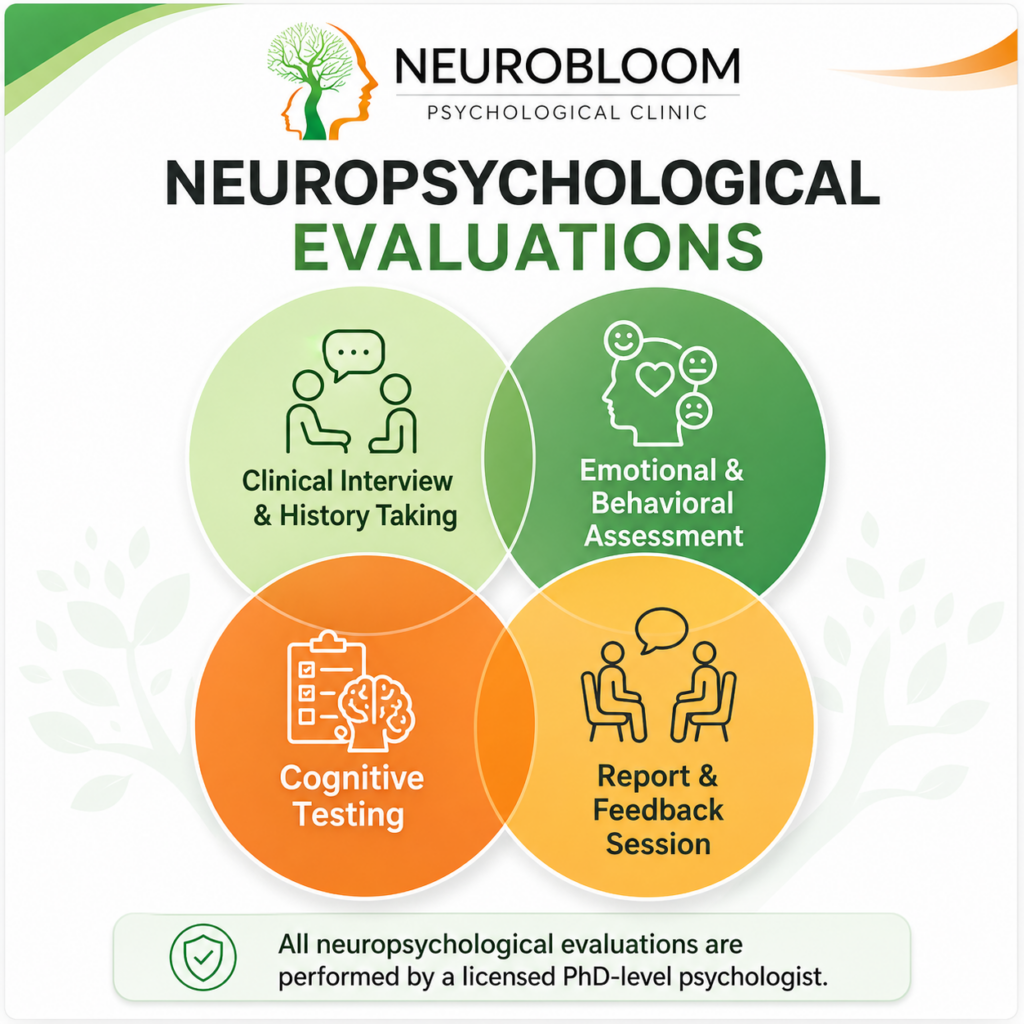
What Happens During a Child Neuropsychological Evaluation?
The evaluation process generally includes several steps.
1. Initial Consultation
The clinician gathers information about the child’s development, medical history, academic performance, behavior, emotional functioning, and current concerns.
Parents may also be asked to provide school records, previous evaluations, medical information, or teacher feedback.
2. Individualized Testing
The child completes carefully selected tasks and assessments based on the referral questions and concerns. Testing may examine attention, memory, language, learning, academic abilities, executive functioning, and emotional development.
The evaluation is tailored to the child rather than using the same limited testing process for every family.
3. Review and Interpretation
The clinician reviews the test results along with the child’s history, observations, records, and information provided by parents and teachers.
The pattern across these sources is often more meaningful than any individual score.
4. Personalized Report and Recommendations
Families receive a detailed report explaining the findings in clear language. Recommendations may address:
- School accommodations
- Individualized Education Program or 504 Plan considerations
- Learning strategies
- Therapy or behavioral support
- Medical consultation
- Home routines
- Executive functioning strategies
- Additional services or referrals
At Neurobloom, reports are personally prepared by doctoral-level clinicians and are designed to provide useful, individualized guidance rather than a generic summary.
How Testing Can Help at School
Neuropsychological testing can provide valuable information for parents, educators, and school support teams.
The results may help explain why a child is struggling and identify accommodations or interventions such as:
- Extended time for assignments or tests
- Reduced-distraction testing environments
- Written and verbal instructions
- Assistive technology
- Reading or math intervention
- Organizational support
- Breaks during longer tasks
- Changes in workload or instructional methods
While an outside evaluation does not automatically guarantee school services, it can provide important documentation for discussions regarding an IEP, 504 Plan, or other educational support.
Neuropsychological Evaluations in Novi and Surrounding Communities
Neurobloom Psychological Clinic provides neuropsychological evaluations for families in Novi and throughout surrounding areas of Southeast Michigan.
Families may visit from communities including:
- Northville
- Farmington Hills
- Wixom
- Walled Lake
- Commerce Township
- West Bloomfield
- Livonia
- South Lyon
- Plymouth
- Canton
Families do not need to wait until a child is failing or experiencing a crisis to seek answers. Early evaluation can help identify needs, reduce frustration, and guide more effective support.
When Is the Right Time to Schedule an Evaluation?
It may be time to consider testing when a child’s difficulties are affecting academic progress, confidence, relationships, emotional well-being, or daily functioning.
An evaluation may also be appropriate when:
- Previous interventions have not worked
- A diagnosis does not fully explain the child’s challenges
- Parents need documentation for school support
- A child is transitioning to a new school or academic level
- Teachers and parents have ongoing concerns
- The family wants a clearer understanding of the child’s strengths and needs
When families have clear information, they are better equipped to make decisions and advocate for the right support.

Frequently Asked Questions
What is the difference between psychological testing and neuropsychological testing?
Psychological testing may focus on emotional functioning, behavior, personality, or a particular diagnosis. Neuropsychological testing generally examines a broader range of cognitive, academic, behavioral, and emotional abilities to understand how different areas of functioning work together.
Can neuropsychological testing diagnose ADHD?
A comprehensive evaluation can help determine whether a child meets the criteria for ADHD. It can also examine anxiety, learning disabilities, executive functioning, processing speed, and other factors that may cause similar symptoms.
Can testing identify a learning disability?
Yes. Learning disability testing may evaluate reading, writing, mathematics, language, memory, processing, and intellectual abilities. The clinician reviews patterns across these areas to determine whether a specific learning disorder may be present.
Does my child need to be referred by a doctor or school?
Referral requirements can vary. Families can contact Neurobloom Psychological Clinic directly to discuss their concerns, the evaluation process, and any insurance or documentation requirements.
How long does a neuropsychological evaluation take?
The length of an evaluation depends on the child’s age, concerns, and the areas being assessed. Testing may occur during one extended appointment or across multiple appointments.
Will the evaluation provide recommendations for school?
When appropriate, the final report may include recommendations for classroom accommodations, academic interventions, learning strategies, and discussions with the child’s school support team.
What should parents bring to the first appointment?
Parents may be asked to provide report cards, school testing, IEP or 504 Plan documents, medical records, previous evaluations, teacher feedback, and a list of current concerns.
Are neuropsychological evaluations only for children who are struggling academically?
No. Evaluations may also address attention, behavior, anxiety, memory, social development, executive functioning, developmental concerns, or changes following an illness or injury.
Schedule a Neuropsychological Evaluation in Novi, Michigan
When a child is struggling, families deserve more than guesswork.
A comprehensive neuropsychological evaluation can help identify the factors affecting your child and provide clear, individualized recommendations for moving forward.
Neurobloom Psychological Clinic offers child neuropsychological evaluations in Novi, Michigan, for families throughout Northville, Farmington Hills, Wixom, Walled Lake, Commerce Township, West Bloomfield, Livonia, South Lyon, Plymouth, Canton, Detroit, and nearby communities.